
New units in ECs with tenders closing on or after 24 Aug 2026 have an S$18,000 household income ceiling; other units stay at S$16,000. HDB's EC page counts everyone listed; its HFE guidelines exclude bonuses, which on our reading applies to ECs too. At either ceiling, the 30% MSR caps the loan near S$1.0 to S$1.13 million; no grant.
What is the EC income ceiling in 2026, and which one applies?
Two ceilings run side by side. Which one you face depends on the EC site's land sale tender, not on when you apply. HDB's EC eligibility page (updated 25 Aug 2026) defines the ceiling as the total income of all persons listed in the EC application.
| EC units | Monthly household income ceiling |
|---|---|
| New units in ECs with land sale tenders closing on or after 24 Aug 2026 | S$18,000 |
| New units in ECs with tenders awarded before 24 Aug 2026 | S$16,000 |
| Balance units in existing ECs | S$16,000 |
The rise from S$16,000 to S$18,000 was announced at the National Day Rally on 23 Aug 2026, and HDB published the detail the same day. HDB says the revised ceiling does not apply to balance units in existing ECs, or to new units in ECs whose tenders were awarded before 24 Aug 2026. Check which ceiling applies to a given project on the EC launch tracker or with the developer. For the other EC rule changes, see the new EC rules. For a pass or fail check on your own numbers, use the EC eligibility calculator. This page explains the sums behind it.
How does HDB count household income?
HDB's EC pages do not spell out a month-by-month method for the ceiling. What HDB does publish is its income guidelines for the HFE letter (the eligibility letter for flat purchases and grants), last updated 24 Jul 2026. These are the rules for counting household income:
- Who counts: every person listed in the application, applicants and occupiers.
- Which months: a 12-month assessment period that ends 2 months before the month you apply. HDB's own example: apply in May 2024, and the period runs Apr 2023 to Mar 2024.
- How it is averaged: total income divided by the months worked in the period. Months on no-pay leave are excluded. For the self-employed, the average runs over 12 months or from when the business started.
- Gross, not take-home: income includes the employee's own CPF deduction. The employer's CPF contribution is left out.
- Counted: allowances and overtime pay (food, transport, laundry, uniform, shift work and so on), claims and reimbursements, director's fees, employee benefits, incentives, overseas cost-of-living allowances, pupillage and stipends.
- Not counted: bonuses, Annual Wage Supplement, employee share options and non-monetary pay, National Service allowance, pension, and income that is not from employment or trade (rent, alimony, dividends, interest).
On documents, HDB says it retrieves income data from Myinfo and may still ask for supporting documents. For an EC, HDB's eligibility page says the property developer guides you on income documents when you book a unit.
Our reading: if the EC ceiling is tested the same way as the HFE guidelines, the 12-month average is why a recent pay rise may not lift you over the line straight away, and why overtime and allowances count while bonuses do not. We have not seen HDB state that the HFE method is the one applied at an EC booking, so confirm with the developer and HDB before you rely on it. Your bank is a separate matter. Banks follow MAS rules, which average variable income such as bonuses and commissions over 12 months and cut it by at least 30%.
What loan and price can a household at the ceiling carry?
An EC loan is capped by the 30% Mortgage Servicing Ratio (MSR), which applies to ECs until their minimum occupation period ends. A separate 55% limit (TDSR) covers all your debts. The table shows indicative sums as at 8 Oct 2026.
Assumptions: no other debts, 30-year loan, 4% a year (the MAS floor rate banks must use to test your repayments), 75% loan-to-value with at least 5% in cash, and one lump sum of cash and CPF for the rest. Stamp duty, fees, CPF rules and age limits are not modelled.
| S$16,000 household | S$18,000 household | |
|---|---|---|
| MSR cap (30%) | S$4,800 a month | S$5,400 a month |
| TDSR cap (55%), no other debt | S$8,800 a month | S$9,900 a month |
| Limit that binds | MSR, S$4,800 | MSR, S$5,400 |
| Indicative maximum loan | about S$1,005,000 | about S$1,131,000 |
| Indicative maximum price at 75% LTV | about S$1,341,000 | about S$1,508,000 |
| Cash and CPF needed (25% of price) | about S$335,000 | about S$377,000 |
| Of which at least 5% in cash | about S$67,000 | about S$75,000 |
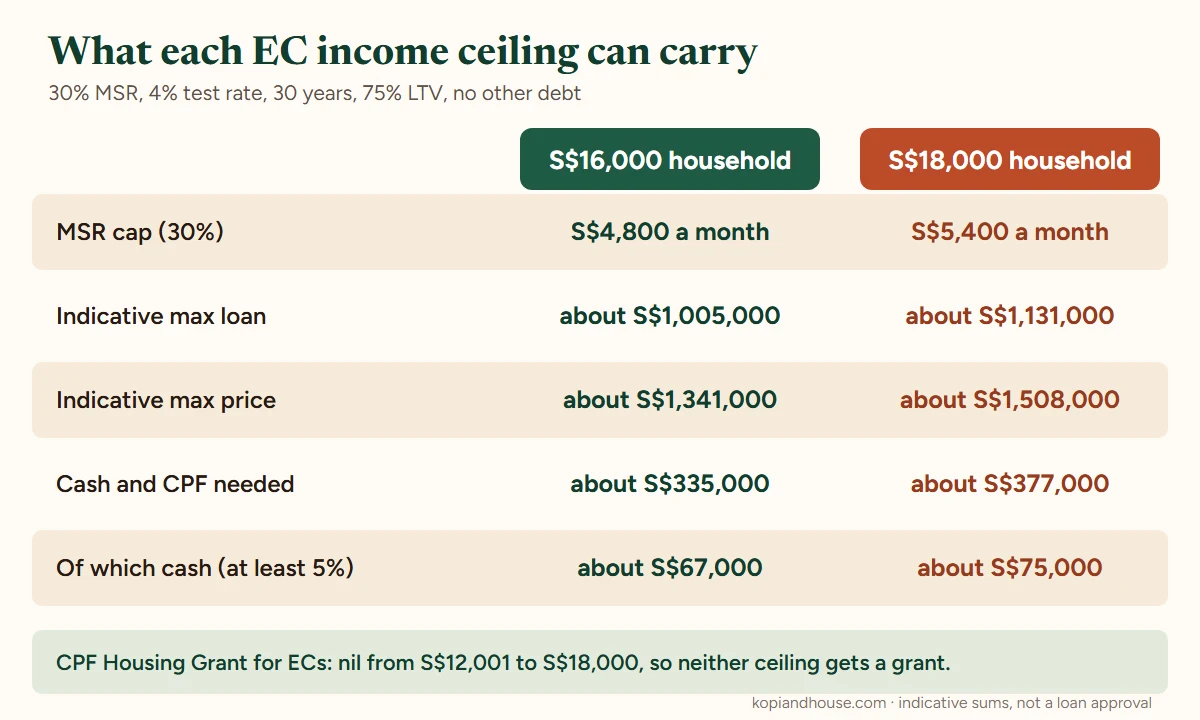
The sums. At 4% over 30 years, each S$1 of monthly repayment supports about S$209.46 of loan. So S$4,800 x 209.46 is about S$1,005,000, and S$5,400 x 209.46 is about S$1,131,000. Divide by 0.75 to get the price: S$1,005,414 / 0.75 is about S$1,341,000, and S$1,131,090 / 0.75 is about S$1,508,000. Figures are rounded to the nearest S$1,000 from unrounded workings, so a subtraction may be off by S$1,000.
TDSR only becomes the tighter limit if your other monthly debts exceed S$4,000 (S$16,000 household) or S$4,500 (S$18,000 household). A car loan and a personal loan together can do it. Our reading: the real constraint for most households at the ceiling is the 30% MSR, not the price tag. The loan is a ceiling, not a target. For more on the two ratios, see TDSR and MSR explained, and for what CPF can fund see using CPF for property.
Not modelled: your bank may cap the tenure differently for an EC, and a loan that runs past age 65 triggers a lower loan-to-value limit of 55%. Check with a bank for your own case.
What CPF Housing Grant does a household at the ceiling get?
None. HDB's EC grant page (updated 24 Aug 2026) offers up to S$30,000 for a household with at least one first-timer core member, tiered by average gross monthly household income of all persons listed in the EC application. The grant stops at S$12,000. A household at or near either ceiling gets no grant.
First-timer households (SC/SC household, then SC/SPR household):
| Average gross monthly household income | SC/SC | SC/SPR |
|---|---|---|
| S$10,000 or lower | S$30,000 | S$20,000 |
| S$10,001 to S$11,000 | S$20,000 | S$10,000 |
| S$11,001 to S$12,000 | S$10,000 | Nil |
| S$12,001 to S$18,000 | Nil | Nil |
First-timer and second-timer couples (SC/SC):
| Average gross monthly household income | Grant |
|---|---|
| S$10,000 or lower | S$15,000 |
| S$10,001 to S$11,000 | S$10,000 |
| S$11,001 to S$12,000 | S$5,000 |
| S$12,001 to S$18,000 | Nil |
An SC/SPR household also gets a S$10,000 Citizen Top-Up when a member becomes a citizen, and the application must be made within 6 months. The grant is credited to the CPF Ordinary Accounts of the first-timer SC core members. It can offset the price or reduce the loan. The HDB grants guide covers the schemes in general.
Where to go next
If your household is under the ceiling, the EC hub and the launch tracker show which sites carry which rules. Prices and launch dates for projects are on those pages once confirmed.
Frequently asked questions
Is the EC income ceiling gross or net?
HDB's EC eligibility page says the ceiling is the "total income" of everyone listed in the application. HDB's EC grant page and its HFE income guidelines use "average gross monthly household income", which counts pay before the employee's CPF deduction and leaves out the employer's CPF. On our reading, the ceiling is therefore tested on gross pay, not take-home pay, so confirm with the developer how it is applied at booking.
Do bonuses and overtime count toward the EC income ceiling?
Under HDB's income guidelines for the HFE letter, bonuses and Annual Wage Supplement do not count, while allowances, overtime pay, incentives, director's fees, claims and stipends do. Our reading is that the same split applies to an EC booking, but HDB's EC pages do not say so, so check with the developer or HDB.
Which ECs still use the S$16,000 ceiling?
New units in ECs whose land sale tenders were awarded before 24 Aug 2026 keep the S$16,000 ceiling, and so do balance units in existing ECs. The S$18,000 ceiling applies to new units in ECs with tenders closing on or after 24 Aug 2026.
What is the maximum EC price at the S$16,000 ceiling?
Our indicative sum is about S$1,341,000, based on a loan of about S$1,005,000 at 75% loan-to-value. It assumes a 30-year loan, the 4% MAS test rate, no other debts and no CPF or age limits. It is not an approval, and your bank's assessment will differ.
What if our income changes before we book an EC?
HDB's EC eligibility page says the developer guides you on income documents when you book a unit. If your income is about to change, ask HDB or the developer before you book.